Security tools multiply
Every provider brings another console, credential model, project map, and operating workflow.

Kangl is the security control plane between Azure DevOps and the providers you trust—giving AppSec teams one operating model for posture, policy, pipelines, and audit.
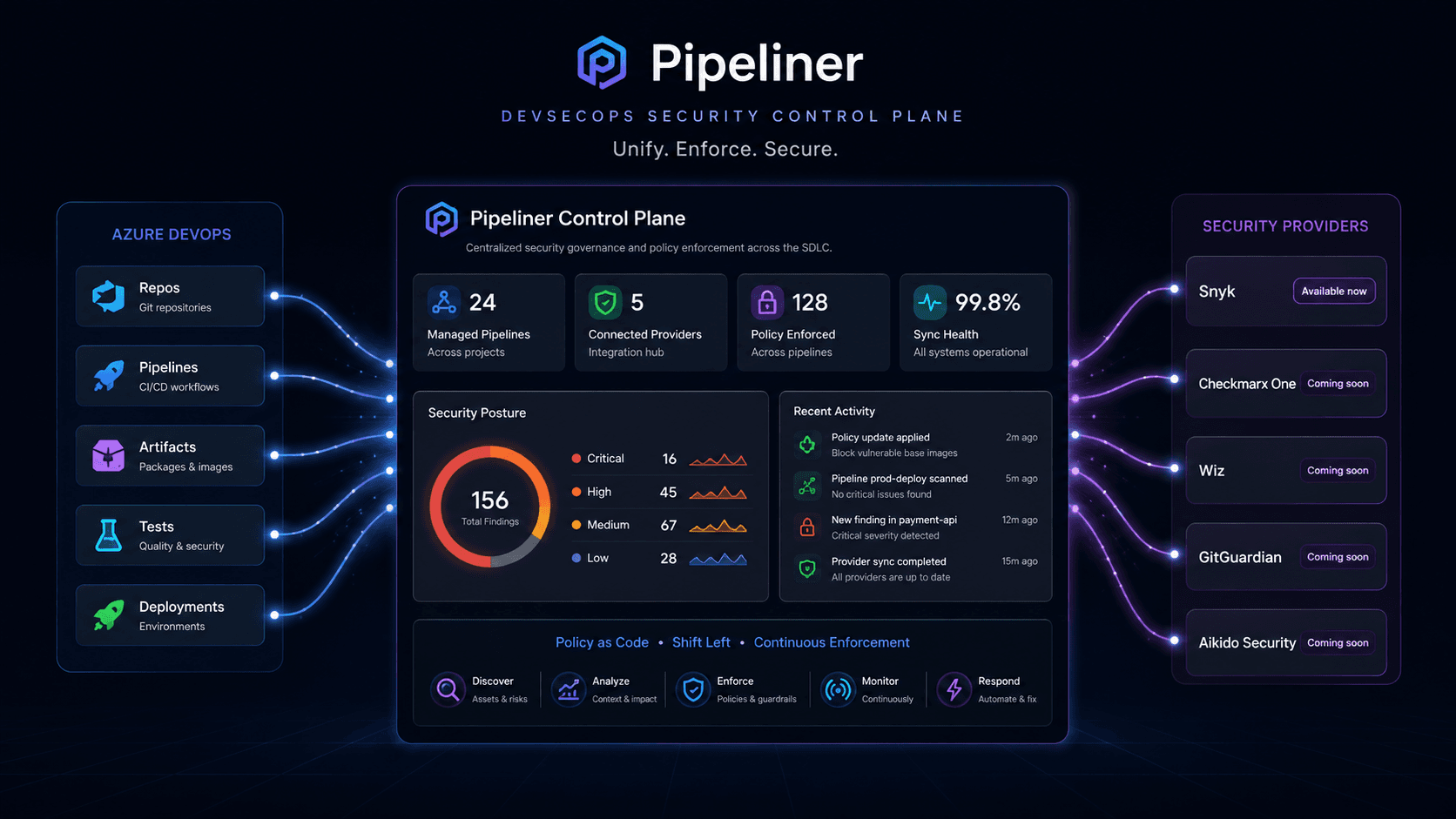

THE MISSING OPERATING LAYER
Stop managing AppSec as a collection of vendor portals and pipeline-by-pipeline settings. Connect the estate once, normalize the signals, and control how security runs.
WHY KANGL
Enterprise teams already own capable security tools. What they lack is one durable control layer across Azure DevOps, providers, repositories, policies, and pipelines.
Every provider brings another console, credential model, project map, and operating workflow.
Security configuration separates from the build pipelines it is meant to protect.
Findings live with scanners while AppSec teams operate repositories, projects, and pipelines.
THE DEVSECOPS COMMAND CENTER
See provider health, managed pipelines, normalized posture, policy decisions, tenant operations, and audit state without crossing six different tools.
Explore the platform →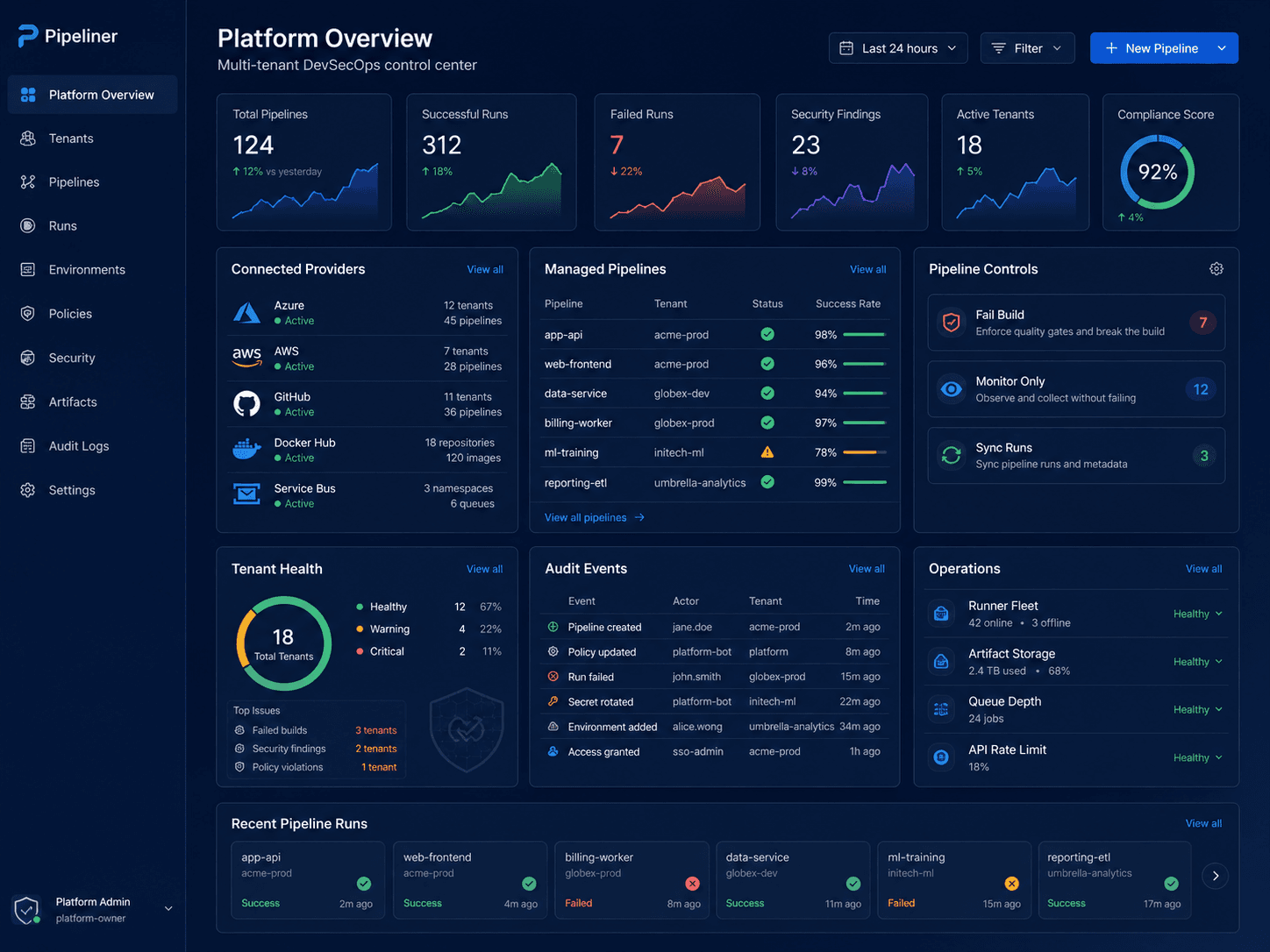
THE PLATFORM
Every capability is designed around the work AppSec and platform teams actually perform—not another disconnected security dashboard.
Connect and manage security platforms through a single provider-neutral control plane.
Normalize security findings into fast, consistent repository-level posture.
Enable, synchronize, and enforce controls across Azure DevOps build pipelines.
Apply backend-authoritative policy and retain durable operational history.
BRING YOUR SECURITY TOOLS
Kangl sits above your security providers. Scanners keep scanning. Kangl standardizes how teams connect, map, govern, synchronize, and enforce them across Azure DevOps.
PIPELINE SECURITY RUNTIME
Connect Snyk once, map organizations, provision projects, configure Kangl Pipeline Security Runtime, and control eligible build pipelines without turning Kangl into another scanner.
Provider validation completednow
Project audit synchronized2m
Runtime policy updated8m
KANGL PIPELINE SECURITY RUNTIME
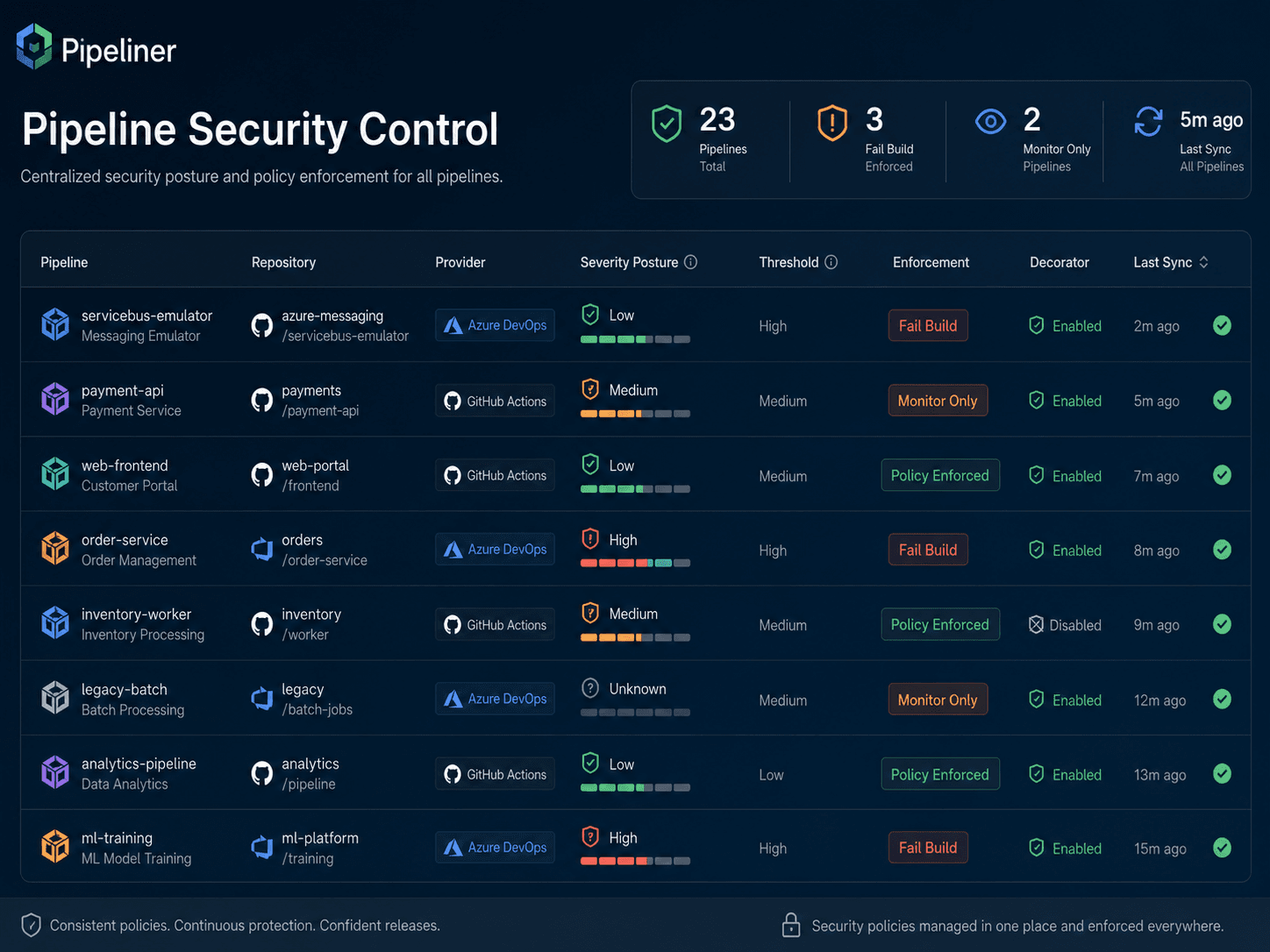
Centralize eligibility, vulnerability posture, policy thresholds, Security Runtime state, bulk operations, drift repair, and Force Sync across YAML and classic build pipelines.
Classic release pipelines are not supported.

FAST SECURITY POSTURE
Provider APIs synchronize asynchronously. Kangl keeps a normalized repository read model ready for the operation—not one vendor call per row.

BACKEND-AUTHORITATIVE POLICY
Evaluate thresholds centrally, make the pipeline decision authoritative, and retain the operational history behind every change.
SELF-OPERATING COVERAGE
Provider estates drift: targets disappear, scans lag, re-runs collide. Kangl absorbs these as reconciliation work for the platform — your team sees attention items only when automation provably cannot proceed.
A resumable server-side wizard takes the estate from discovery to protection — scope, ownership, provider mapping, classification, policy — with a deterministic preflight, one-click execution, and a completion state that stays put across reloads. Recovery reopens at the exact fix step, never a blank form.
When a mapped provider target disappears, Kangl re-enrolls it automatically through the same canonical enrollment lifecycle it used the first time. No duplicate workflows, no phantom runs — and the customer is asked to act only with the exact missing prerequisite named.
Provider evidence arrives asynchronously. Initial assessments converge inside a bounded retry window and pause as retryable when it closes — slow scanners never turn into false failures, and nothing sits “running” forever.
Discovery may use heuristics; operation never does. Once enrolled, every repository is operated by its exact provider organization and target identity — a similarly named resource is never silently substituted.
BUILT FOR ENTERPRISE SCALE
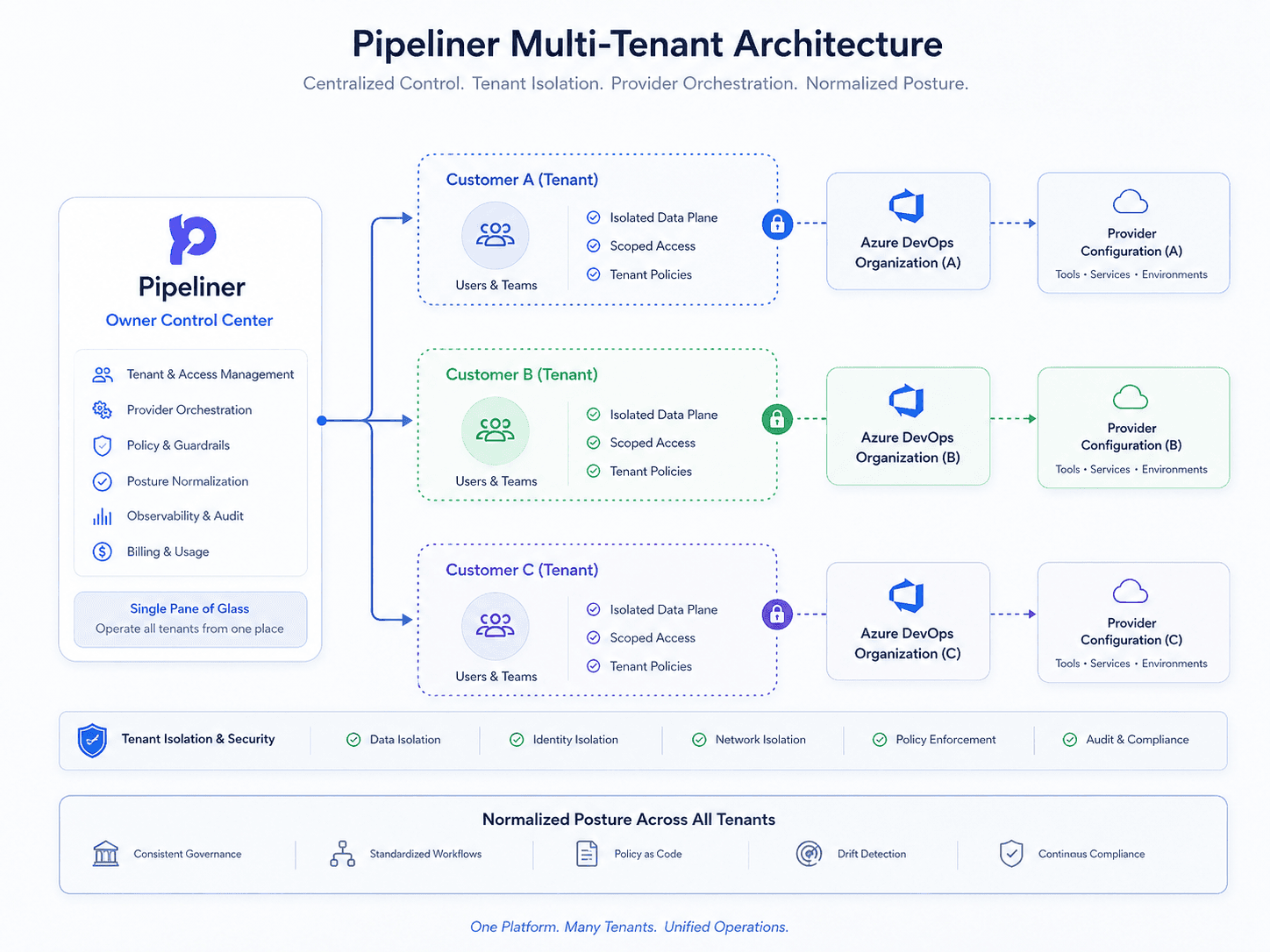
Centralized owner control without collapsing customer boundaries. Preserve tenant-specific configuration, provider isolation, Azure DevOps organization scope, and normalized posture.
ONE PLATFORM · THREE PERSPECTIVES
See what is protected, what blocks, what drifted, and what needs attention.
Coordinate provisioning, Security Runtime state, synchronization, and bulk operations.
Work from durable operational history instead of disconnected vendor events.
FROM THE BLOG
Guides for the layer where security programs succeed or fail: coverage, drift, policy, credentials, and audit across Azure DevOps estates. Browse all articles →
How to run Snyk in Azure DevOps pipelines, choose between pipeline tasks and centralized injection, protect credentials, and keep coverage from drifting.
A practical Azure DevOps pipeline security checklist covering identities, service connections, branch policies, scanners, gates, drift, and audit evidence.
A practical checklist for securing Azure DevOps organizations, projects, repositories, service connections, and build pipelines — and how to keep it enforced.
FREQUENTLY ASKED
No — and deliberately so. Kangl performs no scanning of any kind. It is the control plane that operates scanners like Snyk across your Azure DevOps estate: coverage, policy, drift repair, and audit.
Never. Those are the engines Kangl amplifies. Your scanner keeps detecting; Kangl makes sure it runs on every eligible pipeline, under one policy, with evidence to show for it.
Kangl goes deep on Azure DevOps: YAML and classic build pipelines, Pipeline Security Runtime, PR branch policies, service connections, and variable groups. Depth over breadth is a deliberate choice.
Kangl Pipeline Security Runtime applies security controls during pipeline execution while PR checks protect the merge path. Findings are normalized into posture; a backend policy engine issues the verdict — fail the build or monitor — and every decision is audited.
Yes, by architecture: tenant-partitioned data under row-level security in the database, per-tenant provider credentials, and a separate owner console for platform operations.
Kangl treats canonical identity loss as a reconciliation event first. If the source repository is alive, the connection healthy, and the provider organization authority intact, the repository re-enters the normal enrollment lifecycle automatically. You are asked to act only when automation provably cannot proceed — and then the reason is exact: repair the connection, restore the organization, or choose a mapping.
No. Azure configuration writes require an explicit control claim, and exactly one Kangl workspace can hold it per organization. Every other workspace runs observe-only — it can validate, sync, and read posture, but never change Azure configuration — and migration readiness makes cutover between workspaces explicit.
Choose a plan to start a seven-day trial with a payment method, or book a demo to discuss your Azure DevOps estate. Provider operations remain subject to their supported capabilities and qualification.

SECURITY OPERATIONS, UNIFIED
Start with seven days of full plan access — or see it live with our team first.